

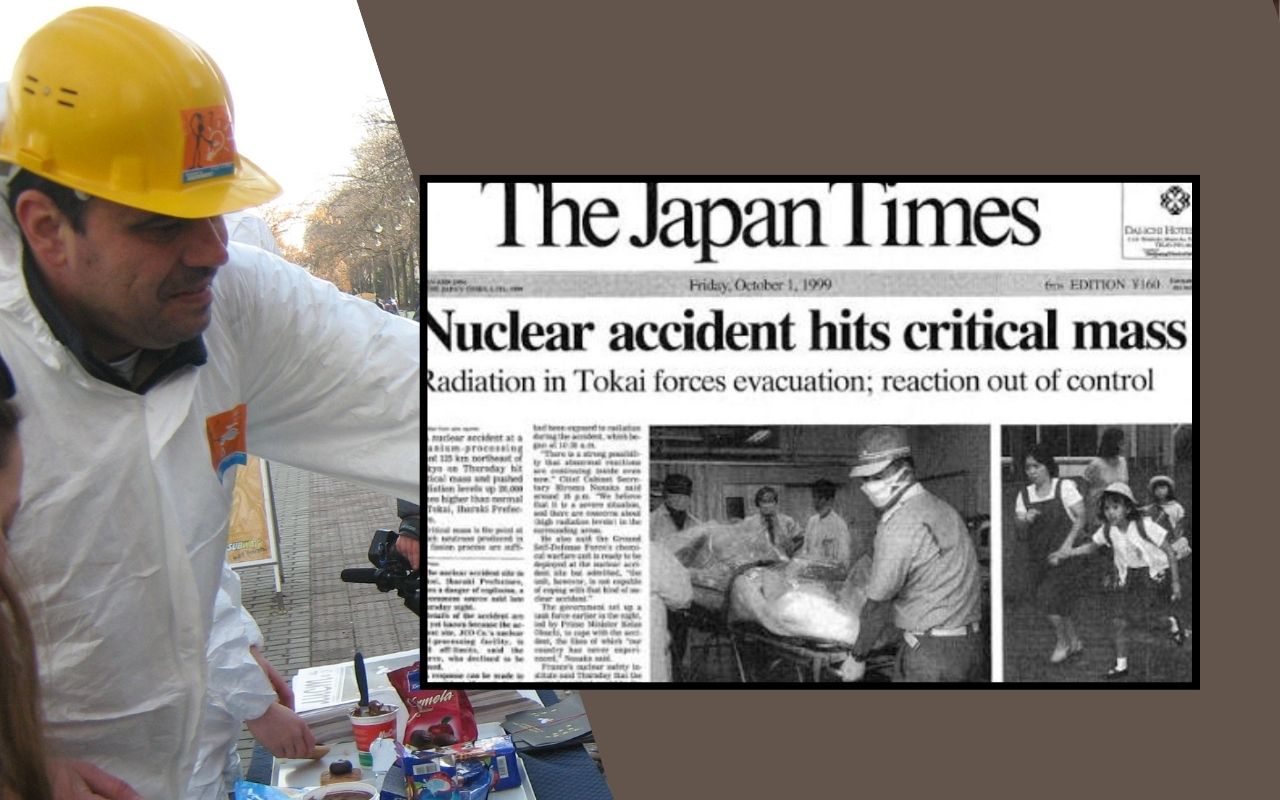

30 September 1999. – 10:35 Local time (01:35 GMT), workers at the JCO plant in Tokai-mura, Ibaraki Prefecture, northeast of Tokyo, inform the rest of the plant’s staff that they have seen a “blue flame rising from the fuel”. There were reports of employees feeling nauseous. This marked the beginning of the worst nuclear accident in Japan’s history until the Fukushima disaster in 2011. The cause was not an earthquake or technical failure, but rather violated procedures.
What happened?
In the factory, a uranium-containing solution was being prepared for an experimental fast neutron reactor. The workers bypass the approved procedure to speed up the work, and pour uranium nitrite solution with an enrichment of around 18.8% into the settling tank. This contains around 16 kg of uranium, compared to the permitted 2.4 kg. This results in the critical mass being exceeded and an uncontrolled chain reaction beginning. At around 10:35 am. The building is flooded with neutron and gamma radiation, and the reaction continues intermittently for almost 20 hours until it is finally stopped.
The damage
The three technicians working directly next to the reservoir receive huge doses. Two of them died after months of painful treatment: Hisashi Ouchi on 21 December 1999. , and Masato Shinohara in April 2000. In total, over 600 people (workers, rescuers and local residents) were exposed to radiation to varying degrees.
The authorities ordered the evacuation of residents in close proximity to the plant, and around 310,000 people within a 10 km radius were urged to stay indoors with their windows closed. The International Nuclear Event Scale (INES) classifies the accident as level 4, but in terms of its impact on people, it is one of the most severe in the civilian nuclear industry since Chernobyl.
Lessons
The investigation revealed systemic problems: insufficient training, lack of real oversight and a culture of compromising safety in the name of speed. The Japanese public, long convinced of the safety of nuclear energy, is shocked. A more stringent regulatory regime and a new law on nuclear emergency preparedness follow.
Tokai-mura reminds us that the weakest link in nuclear safety is often the human factor, rather than the technology. Security depends on discipline, transparency and a culture that does not allow for “shortcuts”.
Here at PECSD, we will continue to share information with you about major incidents and accidents involving nuclear power plants, because this is one of the factors that is always overlooked when we are told that new capacity must be built.